
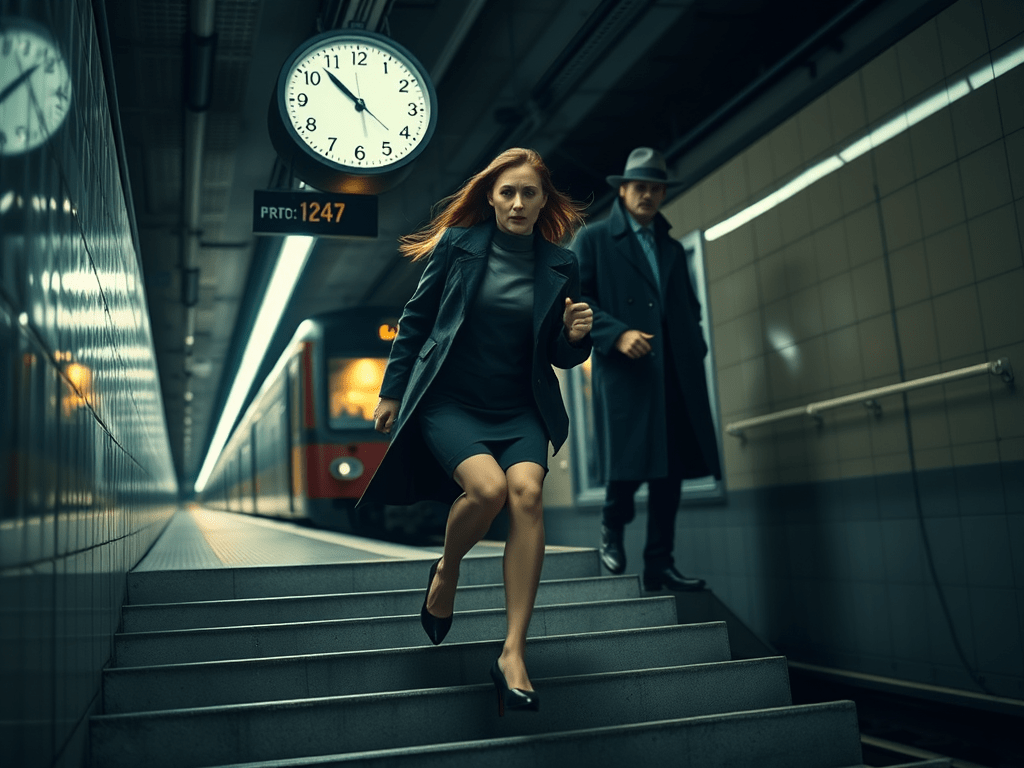
Sarah’s phone buzzed insistently as she hurried down the platform steps. The station clock showed 11:47 PM. She had three minutes to catch the last train.
Her heels clicked against the concrete, echoing in the nearly empty underground station.
The fluorescent lights flickered overhead, casting intermittent shadows that made her quicken her pace. She’d worked late again, losing track of time.
Missing this train meant a two-hour wait until the next one, or an expensive taxi ride across the city.
As she rounded the corner to Platform 7, she nearly collided with a man in a dark coat. He stepped aside without a word, his face hidden beneath the brim of his hat.
Something about his stillness unsettled her. He wasn’t moving toward any platform, just standing there, watching.
The train’s headlight appeared in the tunnel, and Sarah felt relief wash over her. She fumbled for her transit card, but her purse zipper caught.
Behind her, footsteps approached — slow, deliberate.
She glanced back. The man in the dark coat was walking toward her platform.
The train stopped suddenly, its doors opening with a hiss. Sarah got on the nearly empty car and sat in the middle. Through the window, she noticed a man standing on the platform outside.
He was staring directly at her.
The doors began to close. At the last second, a hand shot between them, forcing them back open. And the man in the dark coat stepped inside.
Sarah’s heart hammered as he moved down the aisle. The train lurched forward, and she gripped her purse tighter. There were only two other passengers — an elderly woman dozing near the front, and a teenager with headphones near the back.
The man chose a seat three rows behind Sarah, close enough that she could feel his presence.
At the next stop, the elderly woman awoke. She and the teenager got off. Sarah watched them disappear up the platform stairs, envying their escape.
The doors closed again, leaving her alone with the stranger.
She tried to look at her phone, but the screen’s reflection in the dark window showed the man leaning forward in his seat. It seemed he was reaching into his coat pocket.
Sarah stood abruptly, moving toward the front of the car as the train swayed. She’d get off at the next stop — any stop — and figure out another way home.
Behind her, she sensed the man stand too.
The train began to slow. Through the window, she could see the next station approaching, but something was wrong. The platform was dark, abandoned. A sign flashed past: “Station Closed for Maintenance.”
The train didn’t stop. It rolled through the empty station and continued into the tunnel.
Sarah’s breath caught. She looked at the route map above the door. According to the schedule, her stop was coming up — Millfield Avenue. But between here and there lay three more closed stations, three more stretches of empty tunnel.
Footsteps behind her. Closer now.
She turned around. The man was standing in the aisle, his hand still in his coat pocket. In the harsh fluorescent light, he looked up, and she could finally see his face clearly.
He was smiling.
“Excuse me,” he said, his voice eerily calm. “I think you dropped this.”
He pulled his hand from his pocket and held out her wallet — the wallet that should have been safely in her purse. Her purse that she’d never let out of her sight.
Sarah’s blood turned to ice. If he had her wallet, he could have anything. That meant he had her address. Her keys. Her entire life in his hands.
The train plunged deeper into the tunnel, carrying them both toward an uncertain destination, while outside the windows, the darkness pressed against the glass like something alive.
“Thank you,” she managed to whisper as every instinct screamed at her not to get any closer.
The man’s smile widened. “You’re very welcome, Sarah. I’ve been looking forward to meeting you for such a long time.”
The train’s wheels screeched against the rails as it rounded a curve, and in that moment, Sarah realized with crystal clarity that this was no chance encounter.
This had all been planned.
And she was still three stops away from home.
2
Sarah’s mind raced as she stared at the wallet in the man’s outstretched hand.
How long had he been following her? Days? Weeks? Her fingers trembled as she reached for it, and when their skin brushed, his felt ice cold.
“How did you —?” she began.
“Get your wallet?” He tilted his head, still smiling that terrible smile. “You really should be more careful with your belongings, Sarah. Anyone could take them.”
The train swayed, and she had to grip the metal pole to keep from falling.
Think, she told herself.
The emergency brake was at the front of the car, but he stood between her and it.
Her phone — she could call for help, but they were underground, racing through dead zones.
“What do you want?” she whispered.
“I want you to sit down.” His voice remained conversational, but something had shifted in his tone. “We have time to talk. Plenty of time.”
Sarah glanced at the route map again. Two more closed stations before Millfield Avenue. At least fifteen minutes in this metal tube with him. She moved slowly back to her seat, her legs unsteady.
He followed, settling into the seat directly across from her now. This close, she could see the details that made her stomach lurch — the way his coat was too clean, as if he’d dressed specifically for tonight. The fact that he wasn’t sweating despite the warm train car. The small, precise movements of someone who had rehearsed this moment.
“You work late every Tuesday,” he said matter-of-factly. “Floor 12, northeast corner office. You always take the 11:50 train.”
“You’ve been watching me.” It wasn’t a question.
“For three months now. You’re very predictable, Sarah. Most people are, once you learn their patterns.”
The train began to slow again, and through the window, another dark platform flashed by. Station Closed. Two more to go.
“I have to ask,” he continued, leaning forward slightly. “Do you remember Marcus Chen?”
The name hit her like a physical blow. Marcus — her case from two years ago. The prosecution that had made her career. The man who’d received a life sentence because of her meticulous legal work.
“I see you remember,” the stranger said, noting her expression. “Marcus was my brother.”
Sarah’s throat went dry. “He was guilty. The evidence was overwhelming.”
“The evidence you manufactured.” His smile never wavered, but his eyes had gone completely cold. “The witness testimony you coached. The forensics you manipulated.”
“That’s not true.” But even as she said it, fragments of memory surfaced — corners cut, pressure from her firm to win at any cost, small compromises that had snowballed into something larger.
“Marcus died in prison last month,” he continued. “Stabbed in the yard by another inmate. My baby brother, who never hurt anyone in his life.”
The train shuddered as it hit a rough patch of track. Sarah sat, her mind spinning. Marcus Chen had been guilty — she was certain of it. Wasn’t she?
“I don’t know what you think you know,” she said, trying to keep her voice steady, “but your brother was convicted by a jury of his peers. I just presented the case.”
“You presented lies.” He reached into his other pocket and pulled out a thick manila envelope. “Seventeen pieces of evidence that were never submitted to the defense. Witness statements that were altered. Lab results that were buried.”
He slid the envelope across to her. Sarah stared at it, afraid to touch it, afraid of what she might find inside.
“Open it,” he said softly.
The train was again coming to one more station. One more chance to run.
But as her fingers touched the envelope’s edge, Sarah realized she was no longer sure she deserved to escape. The weight of what she might have done — what she might have convinced herself was justified — pressed down on her like the tons of earth above the tunnel.
“What are you going to do to me?” she asked.
“That depends,” he said, “on what you’re going to do about what’s in that envelope.”
The train screeched to a halt at Millfield Avenue. The doors opened with the familiar hiss, and cool night air rushed into the car. Sarah could see the platform — brightly lit, safe, leading to the stairs that would take her home.
The man made no move to stop her. “Your choice, Sarah. Walk away and pretend this never happened. Or take the envelope and find out what really happened to Marcus Chen.”
Sarah stood on shaking legs, the envelope clutched in her hands. Through the open doors, she could see the station clock: 12:23 AM. In thirty seconds, the doors would close and the train would continue to the end of the line, taking this stranger and his terrible envelope with it.
She could walk away. Go home. Forget this night ever happened.
But as she looked at the envelope, she knew she’d never forget. The question that would haunt her forever: What if Marcus Chen had been innocent?
The warning chime sounded. The doors began to close.
Sarah stepped backward into the train car.
3
The doors sealed shut with finality, and the train lurched forward into the darkness beyond Millfield Avenue. Sarah had crossed a line she couldn’t uncross. The stranger — Marcus’s brother — watched her with something that might have been approval, or might have been pity.
“What’s your name?” she asked, still clutching the envelope.
“David Chen.” He settled back in his seat as the train picked up speed. “And now we ride to the end of the line.”
Sarah’s hands shook as she opened the envelope. The first document made her stomach drop — a police report she’d never seen, dated three days before Marcus’s arrest. It described an alibi witness who placed Marcus at a community center across town during the time of the murder. The witness’s statement was detailed, credible, and had never been disclosed to the defense.
“This should have been in discovery,” she whispered.
“Keep reading.”
The next document was worse — a forensics report showing that the DNA evidence had been contaminated during processing. The contamination made the results unreliable, but a second report had been filed claiming the samples were pristine. Sarah recognized the signature on the false report: Detective Ray Morrison, her key investigator on the case.
Her hands moved faster through the papers. Witness coaching notes in her own handwriting, more brutal than she remembered. Photos of evidence that had been tampered with. Financial records showing payments made to witnesses who changed their stories.
“I didn’t know,” she said, but her voice sounded hollow even to herself.
“Didn’t you?” David’s voice was quiet now, almost gentle. “Or did you choose . . . not to know?”
The train had entered some kind of maintenance yard. Through the windows, Sarah could see abandoned cars on side-tracks, their windows dark and broken. This wasn’t a regular station — this was where the trains came to die.
“My firm,” she said, pieces clicking into place. “They were desperate for a conviction. The victim was a city councilman’s daughter. The pressure was enormous.”
“And you were a junior prosecutor, ambitious, willing to do whatever it took to win.”
She looked up from the papers. “How do you know all this?”
“Because Marcus never stopped believing in the system, even after it failed him. He spent two years in prison writing letters, filing appeals, trying to prove his innocence. He sent me copies of everything — every document he managed to get, every lead he followed. He made me promise that if something happened to him, I’d make sure the truth came out.”
The train was slowing now, approaching what looked like the end of the line.
Ahead, Sarah could see a concrete barrier and darkness beyond.
“What do you want me to do?” she asked.
“What do you think you should do?”
Sarah stared at the documents in her lap. Each page represented another nail in Marcus Chen’s coffin, another lie that had built the case against an innocent man.
Her case. Her lies.
“I could lose everything,” she said. “My career, my reputation. I could face criminal charges myself.”
“Yes.”
“Morrison is probably long retired. The witnesses might be impossible to find. Some of the evidence might be destroyed by now.”
“Probably.”
The train came to a complete stop. The lights went out, leaving them in darkness except for the dim emergency lighting. In the silence, Sarah could hear her own breathing, fast and shallow.
“Why didn’t you just expose this yourself?” she asked. “Why involve me?”
His voice came from the darkness across from her. “Because I needed you to see it. To understand what you did. Justice isn’t just about punishment, Sarah. It’s about acknowledgment. About making things right.”
The lights flickered back on. He was standing now, moving toward the doors.
“Where are you going?”
“Home,” he said simply. “My work here is done.”
“Wait.” Sarah stood, the papers falling to the floor around her feet. “What if I don’t do anything? What if I just walk away and pretend this never happened?”
He paused at the door, his hand on the emergency release. “Then you’ll have to live with that choice for the rest of your life. But Marcus can’t live with it, can he? He’s dead.”
The door opened with a mechanical grinding sound. Cold air rushed in, carrying the scent of rust and abandonment.
“There’s a maintenance walkway that leads back to the surface,” he said.
“Follow the yellow line painted on the wall. It’ll take you about twenty minutes to walk out.” He turned.
“Wait —”
But he was gone, disappeared into the maze of abandoned train cars and maintenance equipment. Sarah stood alone in the doorway, the wind whipping through her hair, the damning documents scattered at her feet.
She could leave them there. Walk away. Climb up to the street and hail a taxi and go home and pretend none of this had ever happened. In the morning, she could convince herself it had all been a dream, a nightmare brought on by stress and too much coffee.
Or she could gather up the papers and do what she knew was right.
Sarah knelt and began collecting the documents, her hands steady now for the first time all night. As she stacked them carefully back in the envelope, she thought about Marcus Chen — a man she’d never really seen as human during his trial, just an obstacle to overcome, a case to win.
She thought about his brother, David, who had orchestrated this entire encounter not for revenge, but for something harder to achieve: Truth.
And she thought about herself, about the prosecutor she’d been and the person she could choose to become.
The yellow line stretched ahead of her in the darkness, leading back to the world above. Sarah tucked the envelope under her arm and began to walk, each step taking her closer to a conversation she’d have to have with her boss in the morning — a conversation that would end her career and possibly her freedom, but might finally let Marcus Chen rest in peace.
Behind her, the empty train sat quietly, silent in the darkness, its job finally done.
____________________
© Secret Agent Man
info@secretagentman.net
 Secret Agent Man
Leave a comment